
Rats in Drains: How They Get In and Who Fixes What
By Henry, Taff Pest Control · Reviewed October 2026
Rats in drains are nothing unusual. Sewers give them water, shelter and food waste, and a sound drain keeps them in the pipe. Trouble starts when a drain lets them out, and the usual way out is a joint where two pipes have shifted. In Cardiff’s older streets, that’s one of the commonest ways rats reach a house.
How rats get out of the sewer and into a house
To a rat, a sewer is a road network, and the usual way off it is a shifted joint. Where two lengths of pipe have moved against each other, the step between them gives a rat an edge to gnaw. It gnaws its way out, then tunnels along the outside of the pipe until it finds a cavity wall or another way into the house. Cracked and broken pipes happen too, but far less often.
Plenty of Cardiff’s Victorian and Edwardian terraces, in Pontcanna, Penylan and beyond, still sit on drains as old as the houses, with joints that have had over a century to move.
Rainwater gullies are the other common way out. Where a gully pot drains into the sewer, rats often gnaw through its plastic parts, which puts them at ground level right beside the house.
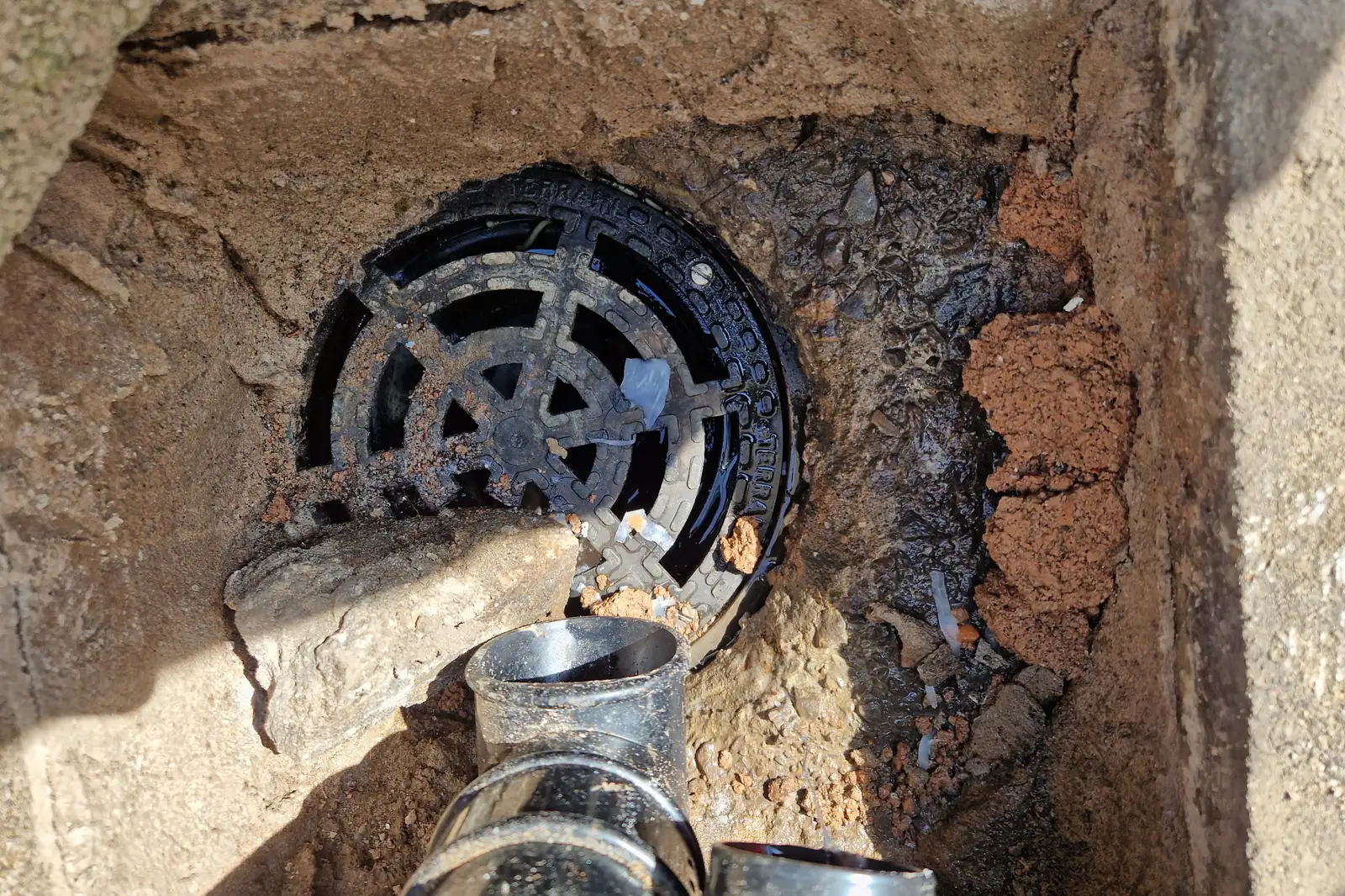
Extensions are the classic Cardiff case. An unused drain run ends up under the new floor, still connected to the sewer, and sometimes nobody caps it. A rat that finds the open end is a short dig from the cavity wall, and concrete slows it down rather than stopping it.
Signs the drains are the route
On top of the usual signs of rats in the house, drain routes leave clues of their own.
Activity by a drain. Burrows or droppings beside an inspection chamber or drain cover.
A chewed gully. Gnawed plastic on a rainwater gully, or disturbed soil around it.
Gnawing around pipes. Chewed edges or new holes where a waste or soil pipe comes through a wall or floor, under the sink or behind the bath panel.
A rat in the bathroom. Very occasionally, one comes up through the toilet: alarming, and a plain sign that rats are in the pipes right up to the house.
Rats that keep coming back. Trapping clears them, then the signs return, because the way in is still open.
Why trapping alone won’t fix it
Traps deal with the rats already inside, not the gap they came through, and on a drain route there are more rats behind it. Poison has the same blind spot, and we rarely use it on rats anyway: a poisoned rat tends to die out of reach, under a floor or in a wall, where the smell can last for weeks. The job is finding the defect and getting it closed.
How the route is found
Rat work runs to a minimum of three visits, often more, each building on the last in no fixed order.
Detection baits. Non-toxic baits go into the drains and other likely spots; gnawed bait shows which runs are in use.
Tracing. Rats that cross UV tracing gel carry it on their feet, and a UV torch shows where they went.
A camera survey. When the evidence points underground, a drainage firm we trust runs a small camera along the pipe, usually from an inspection chamber. It films shifted joints, cracks, roots and any old branch still open. They quote for it separately, and nothing is arranged without you knowing first.
Decking. It’s good cover for burrows and chambers, so we may ask for a few boards to be lifted.
What fixes it, and who does the work
Repairing a shifted joint, relining a pipe, capping an old branch or replacing a chewed gully is drainage work, and we don’t do it. We’ll set out what’s needed, point you to a drainage firm we trust and check the work on a follow-up. The rats, and our own proofing (mesh, anti-gnaw wire, gap-filling), stay with us.
The exception: a one-way rat valve, also called a non-return valve or rat flap. It sits inside the drain, often in an inspection chamber, and lets waste flow out, then drops shut against anything coming the other way. Henry may fit one where it suits the job. A valve mends nothing, though. Rats already on the house side still need trapping, and the flap needs the odd check, because one jammed open by debris stops nothing.
Whose pipe is it?
Who pays for a repair depends on whose pipe the fault is in. On 1 October 2011, shared sewers and lateral drains in England and Wales passed to the water companies: in Cardiff, Dŵr Cymru Welsh Water.
| The pipe | Usually the responsibility of |
|---|---|
| Serves only your property and sits inside your boundary | You (or your landlord) |
| Your drain once it leaves your boundary (a lateral drain) | Welsh Water |
| Shared with neighbours (a sewer), wherever it runs | Welsh Water |
Not sure where yours stops? Welsh Water’s guidance has a diagram, and they’ll help work out who owns a pipe.
What to do in the meantime
Leave drain covers and chambers alone. Covers are heavy, and sewage and rat urine can both carry infections.
Don’t pour poison or chemicals down the drain. Neither closes the route, and a poisoned rat can die where nobody can reach it.
Keep toilet lids down. If a rat ever does come up, a closed lid keeps it in the pan.
Hold off blocking holes. Sealed too early, a route can shut rats in, and the marks around it are evidence we’d rather read first.
Common questions
How do rats usually get out of a drain?
Most often at a joint where two pipes have shifted. The step gives them an edge to gnaw; they gnaw their way out, then tunnel along the outside of the pipe until they find a cavity wall or another way in. Chewed plastic rainwater gullies are the other common route.
Can a rat really come up through the toilet?
It can, though it’s rare: rats swim well enough to get through the water in the U-bend. If one appears, close the lid, put something heavy on it and shut the bathroom door, so it stays in one room. Then call us: the drain needs looking at.
Do you carry out drain surveys or repairs?
No. Camera surveys and repairs go to a drainage firm we trust, which prices that work itself. The only drain fitting Henry may do is a one-way rat valve, where it suits the job.
We live in a terrace. Are our drains shared?
Often, yes. In many terraces one pipe runs behind several houses. A pipe serving more than one property counts as a sewer, so it’s normally Welsh Water’s to repair.
Is there a season for rats in drains?
No. Rats live in the sewers all year, so a faulty drain is as much a way in during July as in January.
Our page on rat control in Cardiff sets out how the visits run, drains included. Or get in touch with what you’ve found so far, and we’ll talk it through.